Ideal Traits for Public Access Service Dog Candidates
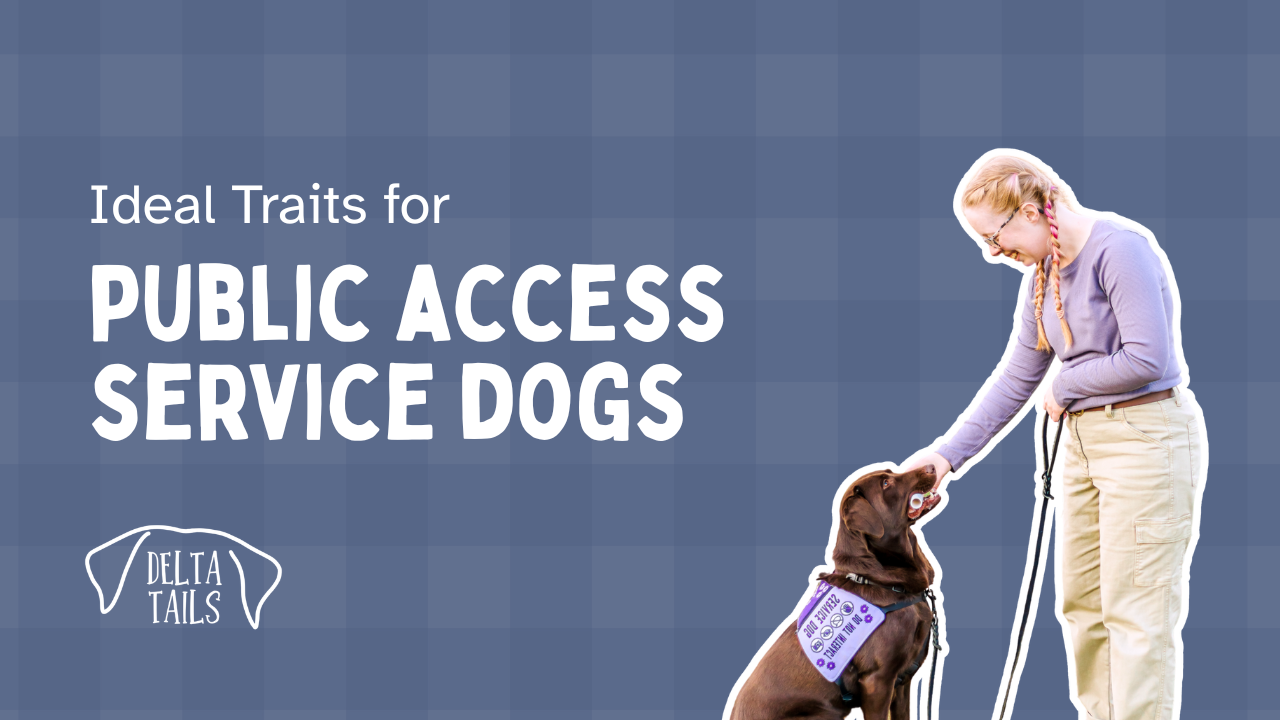
Public access work is a difficult ask for any dog.
But selecting a dog who fits the ideal traits to be able to cope with the stressors of public work is the best way to find success.
When researching for this post, I found the majority of trait lists available today vague and too subjective, so I wrote this post with the intention of adding more detail and traits outside of the usual ones to help make your decision.
With that, here's my unofficial always-adding-things on ideal trait list for service dog prospects:
1. Non-aggressive or Reactive
Public access service dogs cannot be aggressive or reactive. This can mean both growling, barking, snapping, biting, etc, and also over the top excitement that is difficult to control and manage. This should be not happening around dogs, people, strangers handling them, or even things like wildlife.
Even if your dog does not display the behavior out in public (for example, resource guarding bones at home), it is important to pull them from public work immediately. These behaviors are often signs of pain (see Mills et. al, 2020) and at the very least, stress, which is not appropriate for public work.
In the United States, dogs with a bite history are not legally able to work as service dogs, and they can be removed from any public space for aggressive or reactive behaviors.
2. Sociable and tolerant with people and dogs.
Service dogs don't have to be everybody's best friend or want to play with everyone and everything, but they need to at least be comfortable and relaxed with any new person or any new dog. If they are highly sociable and excited to see people and dogs, they need to be easily redirected so that you're not constantly having to fight for their focus around people and dogs.
Even when a person or dog does something a bit "rude," the dog's response should be to calmly move away or tolerate the behavior. This does not mean that we should teach our dogs by yanking their tail or tugging their ears (a common practice in the service dog world). This is a natural trait and response to look for.
3. Not easily stressed or startled.
This is a frequency type of trait. Every dog will have periods of stress or startle from certain stimuli, but a public access service dog should rarely display these behaviors. Signs of stress or startling on every outing is a sign that your dog might not be the best fit for public work.
All public work is inherently stressful, so we need a dog who finds the majority of public stimuli to be non-stressful in order to cope with the stressors that are inevitably present.
4. Low startle or stress responses.
When a stressful situation or stimuli does happen, I like to make sure that the behaviors that they show are not explosive or difficult to manage. For example, a dog who startles by jumping a little bit is a lot easier in public than a dog who startles by releasing several barks and skittering away.
I also like to look for dogs who stress down instead of stressing up. An example of this is my two personal dogs. My border collie is the kind of dog who stresses up. When he notices something that he's afraid of or overexcited by, he will continually escalate his reactions (typically loud barks and posturing), unless I actively break that fixation or focus by making distance. This is largely due to his pain condition, so this is also something that can be influenced by pain and discomfort.
My labrador, Quimby, has always been very different. When she is stressed, she tends to freeze or get really quiet. Her body slows down and even sometimes stops altogether to sit and watch.
As you can imagine, this slowing down response without barking is much easier to manage and more compatible with public settings.
5. Resilient.
This trait has more to do with the response after a stressor and how long it takes a dog to return to their baseline. For public access service dogs, I look for a dog who is able to return back to their baseline very quickly and easily on their own after a stressor or startle.
This looks like a dog who startles and quickly shakes off and returns back to their activities without a ton of arousal or fear built in.
A dog who takes 20 minutes to recover from a stressor is not going to be comfortable in public.
6. Confident with novelty.
Public access service dogs should also be very confident with new things, including surfaces, locations, people, dogs, kids, babies, sights, and sounds. They're going to encounter new things on almost every single outing, so they need to be interested and confident around them, not anxious or fearful.
This looks like a dog who is willing to try anything, and even if they are a little apprehensive, it's easy to encourage them to try without bribery.
7. Not noise sensitive.
This is also a common indicator of pain or discomfort, especially when the sensitivity is generalized to many different types of sounds or levels of sound.
This doesn't mean that they can't startle when something is dropped near them.
They just should not be hyperaware to noises around them and reacting to those noises by barking, lunging, or showing fearful behavior. They shouldn't be constantly swiveling their ears to listen to every little noise - that gets overwhelming so quickly! They should be mostly unbothered by a majority of the noises present.
Hearing alert dogs should be a bit more aware of sound, but not sensitive to it.
8. Free of painful or uncomfortable conditions.
Service dogs should be free of painful conditions or indicators of pain. If your dog doesn't have a diagnosis but shows postural signs of pain like stiffness in the gait, roaching or swaying in the spine, or intermittently skipping, they should be pulled from public work as well.
Even things like moderate to severe allergies or a sensitive stomach can make public work uncomfortable. I typically see these types of conditions displayed as unpredictability. One outing could be perfect and the next could be a total stressful disaster.
9. Low interest in prey/chasing.
I like to find a dog with low prey or chase behaviors with things like cats, wildlife, cars, bikes, and scooters. This is something that can improve a bit with training, but it's a lot easier to start with a dog who doesn't have those strong desires in the first place.
This is a big reason why dogs like border collies and other herding breeds as well as terriers are not always the best suited for public access work. Many of these dogs were bred to be hypersensitive to movement and changes in the environment in order to work their livestock better. It is a behavior that cannot be overcome with training, only managed. And it deserves an outlet as well.
10. Moderate energy level.
This trait can be a bit flexible to the handler's preferences, but for most handlers, a moderate energy level is best. The dog shouldn't have such high energy needs that the handler struggles to meet them or the dog struggles to be still in exciting places. Most of public access work is waiting around, so it's important that the dog is able to do that comfortably.
The dog also shouldn't be too low in energy, causing motivation to be low as well.
You want a dog who is ready to work and do things but easily switches into relaxation when those things are done.
11. Loves food and treats without pickiness.
Ideally, when working in public, you will be rewarding with food. Food can stay low energy and quiet, and it won't always be appropriate to reward your dog with toys or other types of rewards in public settings.
Additionally, a dog who is picky about what food they will take on outings is displaying signs of stress or potential pain, regardless of a diagnosis or not, and can be difficult to reward during outings.
12. Response to disengagement (patient).
This trait is an interesting one, but one that is actually very helpful when I am working to find a prospect for my students. If you are working with the dog and suddenly stop rewarding and talking to them, will they start barking and whining at you? Are they immediately going to walk away from you and find something else to do? Or do they just kind of wait calmly wondering why you stopped?
I like to select the dogs who wait calmly, since a lot of scenarios like this will happen in public. Think about when an employee approaches you to talk or you see a friend while you are shopping and disengage from your dog for a bit.
This trait can be worked around with training things like default behaviors, but for new handlers especially, starting with a dog who naturally waits calmly is ideal.
13. Tolerant of touch and gear.
Service dogs should be tolerant of touch, even from strangers, and gear changes. If they're not, this is also a common indicator of pain and discomfort.
Gear shyness is brushed off too often as just a training problem, when the majority of gear shy dogs likely have undiagnosed or untreated pain. Unresolvable gear shyness should be investigated thoroughly. Gear shyness can look like running from harnesses or collars or displaying signs of stress when they see the gear, like yawning, lip licking, or scratching.
In public, strangers will touch your dog. It is just a fact of life, unfortunately. Because of this, your prospect should naturally be tolerant of touch from strangers. They don't have to LOVE being touched by strangers, but their response should be minimal and non-aggressive or reactive. For example, leaning away or moving away is an appropriate response, but nipping, lunging, or muzzle punching is not.
14. Free from behavior diagnoses or symptoms.
Service dog candidates should not have any behavior diagnoses. This includes things like canine compulsive disorders, phobias and fears, resource guarding, same sex aggression, and separation anxiety.
Separation anxiety is the one that I see most frequently, and is typically associated with other anxieties like noise sensitivity, as well as painful conditions. It may seem okay to work a dog with separation anxiety, since during work they are with their handlers and not stressed in the moment, but adding additional stressors from public work to a dog who is already dealing with an anxiety based condition is not appropriate.
15. Moderate independence.
I like to look for a dog who has moderate independence. They're not so reliant on you that they need your guidance all the time to feel comfortable and secure, but they're also not so independent that they would rather do everything on their own. I like a dog who is able to make their own decisions but prefers to be guided by the human.
Most task training requires our dogs to task without us cuing them. They'll also need to know when to do certain tasks based on the environment or things like scent when we may be unavailable for guidance. Independence will help them make those decisions quickly and comfortably.
16. Potty trained.
This one is a legal requirement in the USA. Your dog must be fully potty trained and not mark indoors. They should also not be working in a diaper, regardless of the situation. Service dogs in heat should be left at home.
17. Not trained in bite-work or protection or have a bite history.
These two are legal requirements in the USA as well, and should be self explanatory.
18. Biddable.
This trait is displayed by a dog enjoying working and interacting with you intrinsically, without the draw of the rewards. A great example I use to test this is to see whether a dog will try something with me without food or cues in the picture. In puppy testing, this looks like using my hands or body to guide them over different surfaces or through different areas. Puppies who are very biddable usually follow right along with no difference when food is added. Puppies who aren't as biddable typically walk away to find something else to do, or they wander a bit more without some type of reward present.
After reading all of these traits, you might realize that service work is a lot to ask of a dog and requires a unicorn of sorts. Most dogs will not fit these traits, and that's very normal.
Dogs who don't fit these traits are still incredibly valuable, lovable members of society.
Additionally, some of these traits can be adjustable with training or easily compromised based on the handler's experience and needs.
There is so much to consider when selecting a prospect or deciding on your own dog's suitability for public work. When in doubt, ask for help! A professional service dog trainer with experience evaluating prospects can help give you unbiased information to help your decision, or even help select a dog for you.
If you need help, feel free to email me at [email protected]. I can either help myself or refer you to a trainer in your area to work with.
Join the Pupdate!
Meet the Writer

Blythe Bouchard (Neer)
CDBC, CPCFT, CSAT, CCUI, CNWI, FFCT, Puppy Start Right Instructor, Dynamic Dog Practitioner
Hi! I'm Blythe. I've been training dogs professionally since 2019, and it is my life's passion. I love watching dogs and owners come to understand each other better and work together in harmony.
Recent Posts
Join the Pupdate for weekly tips, tricks, and motivation to train your dog at home.