Five Foundation Games to Teach Your Service Dog for Long-Term Success
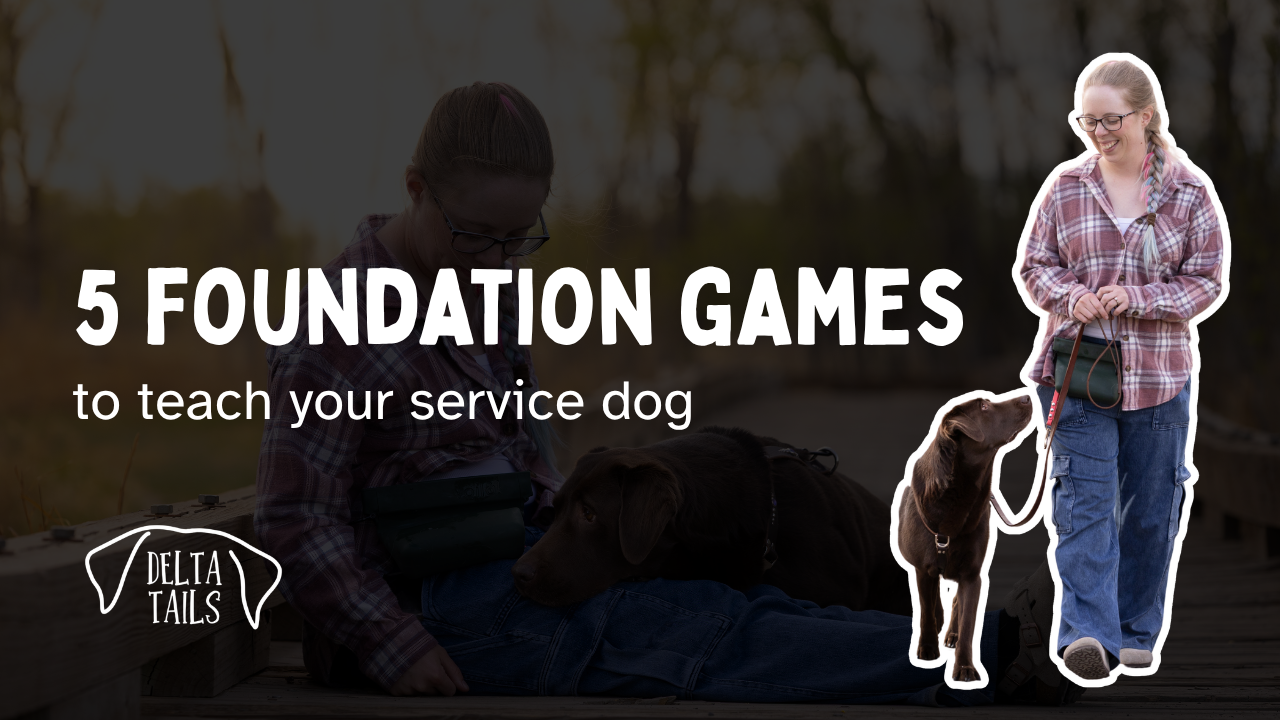
The last few months I've been creating a new set of courses for my Pack Membership that build the foundation of all things service dog training.
In Foundations One, I focused on teaching students how to build an exercise and enrichment plan, nutrition, grooming, and formulating a vet team that will listen.
In Foundations Two, I decided to focus on all things training: reading body language, how dogs learn, how to elicit behaviors to get them on cue, and finally, training games!
These training games are the games that I use for literally every student in the very beginning.
And I thought it would make for a great blog post to share with you the starting point games for free!
That way, if you are DIYing it, you can get great use of them too.
So without further ado, here are five foundation behaviors to teach your service dog for long-term success:
1. The Name Game
This game is SOOOO simple but so under-rated.
Think about all the times you use your dog's name.
Usually, we use it for good things, praise, and treats, but we also typically use it for not so good things like baths, going inside, ending a play session, etc. Sometimes we even use it to scold them.
The name game is an easy way to add positives to the bank of their name.
If your dog doesn't respond to their name, it's much harder to capture their attention for cues for tasks or other behaviors.
If they have a good name response, it can also act as a recall cue!
The name game is super easy. The steps to play are:
- Say your dog's name (in as many different voices and inflections as possible over time).
- Pause. (brief - just so that the name is the important bit for your dog)
- Reach into your treat pouch or pocket and feed a treat straight to their mouth.
- Repeat times 5 million in many different places and environments!
As you can see, this game helps our dogs understand that their name = a treat at the handler.
This means that when you use their name out and about, they are more likely to check in with you! Don't forget to reward for their name every time - just like a recall cue!
2. Treat Scatter Cue
This is another very simple concept, but it allows for another method of rewarding our dogs that can help with distractions, stressful moments, or even over exciting ones!
When dogs sniff, it helps to release feel good hormones and de-stress a bit. A treat scatter can prompt that, allowing for a bit of decompression on cue.
The steps to teach a treat scatter cue are also very simple:
- Use your scatter cue (I say "scatter" to keep it easy.).
- Pause. (brief - just so that the name is the important bit for your dog)
- Reach into your treat pouch or pocket and scatter 3-5 treats into the grass or ground nearby.
- Repeat times 5 million in many different places and environments!
Very similar to the name game, just a different type of cue and delivery.
This is the game that I use to:
- Distract dogs from stimuli they are not ready for (ie dogs too close, loud people, etc)
- De-stress after a stressful stimulus (ie dog barking at them, loud noise, etc)
- Work with reactive or overexcited dogs who need a bit of regulation
- Take a break in a training session
- Reward my dog for anything good. Sometimes scatters are more interesting and fun than a treat to the mouth.
3. Take a Breath
This game was created by Karen Overall and modified later on by Leslie McDevitt. It teaches our dogs to take a deep breath on cue.
It is one of my favorite behaviors to teach because it can help dogs relax into the situation or training session as well as provide a VERY simple behavior to use as a gauge of their readiness to train. If a dog can't take a breath, then the environment, distractions, etc are TOO HARD at that time.
The steps to take a breath are simple, but can be tricky to see at first!
- Slowly raise a treat up near your face and take a deep breath.
- Watch your dog's body, nose, and cheeks for evidence of a breath.
- When they breathe, pop the treat directly in their mouth (no marking!).
- Repeat many times until the breaths get deeper (you'll start to see cheek or nose puffs usually).
Over time, you can fade out holding the treat up and just take a deep breath yourself.
Here's a video tutorial for this one straight from my course since this one is a bit trickier to picture:
4. See, Mark, and Reward
This is another super simple concept (popularized by Kathy Sdao's SMARTx50), but something that I teach to everyone.
The concept is simple. Every day, every walk, every session, if you see something your dog is doing that you enjoy and want more of, mark and reward them!
The "mark" is the word or sound that you use to mean the treat is coming. I use yes or a clicker, but any short word or sound will do.
Some common things to mark and reward are:
- Walking on a loose leash
- Checking in on walks
- Settling on their bed during dinner
- Not whining/barking
- Relaxing while you work
- Waiting at the door before you release them
- Following cues when asked
- Being really really cute
I have handlers place treat jars around their home in frequent rooms to make this easy without having to carry a treat pouch around.
5. Up Down
This is a pattern popularized and named by Leslie McDevitt (you can tell where I've learned from in this post)!
It is yet again, very simple!
This is the second game that I use frequently as an opt in behavior, which just means a simple behavior that, when clean and predictable, shows that the dog is ready to learn and train in a specific environment.
The steps to the game are:
- Place a treat on the ground and let the dog eat.
- Wait.
- Mark when your dog looks up at you (not necessarily eye contact).
- Place the reward on the ground.
- Repeat in a loop.
As you can see, we are rewarding for orienting to the handler by placing the treat on the ground. This is taking the attention off of you and more onto the environment than rewarding to mouth. This is what makes this a great opt in behavior - the dog has a chance to engage in the environment and chooses instead to engage with you and restart the game.
It is also a great refocus game in a pinch to get high rate of rewards and low difficulty for success.
I hope these five games are helpful for guiding some of your foundation work with your service dog.
They have made a huge difference with the teams in my program.
If you'd like to learn more about each of these games and get 1:1 feedback on your work on them, you'd love my membership, the Pack.
In each course, I create training prompts to share within my Q and A community as well as built in training challenges for mastery once you feel your dog is ready to move on. This gives 1:1 feedback from me without the private lesson price tag and is so useful for handlers who like the more DIY route.
You can learn more about the program here: https://www.deltatails.com/service-dogs
Join the Pupdate!
Meet the Writer

Blythe Bouchard (Neer)
CDBC, CPCFT, CSAT, CCUI, CNWI, FFCT, Puppy Start Right Instructor, Dynamic Dog Practitioner
Hi! I'm Blythe. I've been training dogs professionally since 2019, and it is my life's passion. I love watching dogs and owners come to understand each other better and work together in harmony.
Recent Posts
Join the Pupdate for weekly tips, tricks, and motivation to train your dog at home.