
Coercion in Dog Training: Where It's Hidden and How to Avoid It
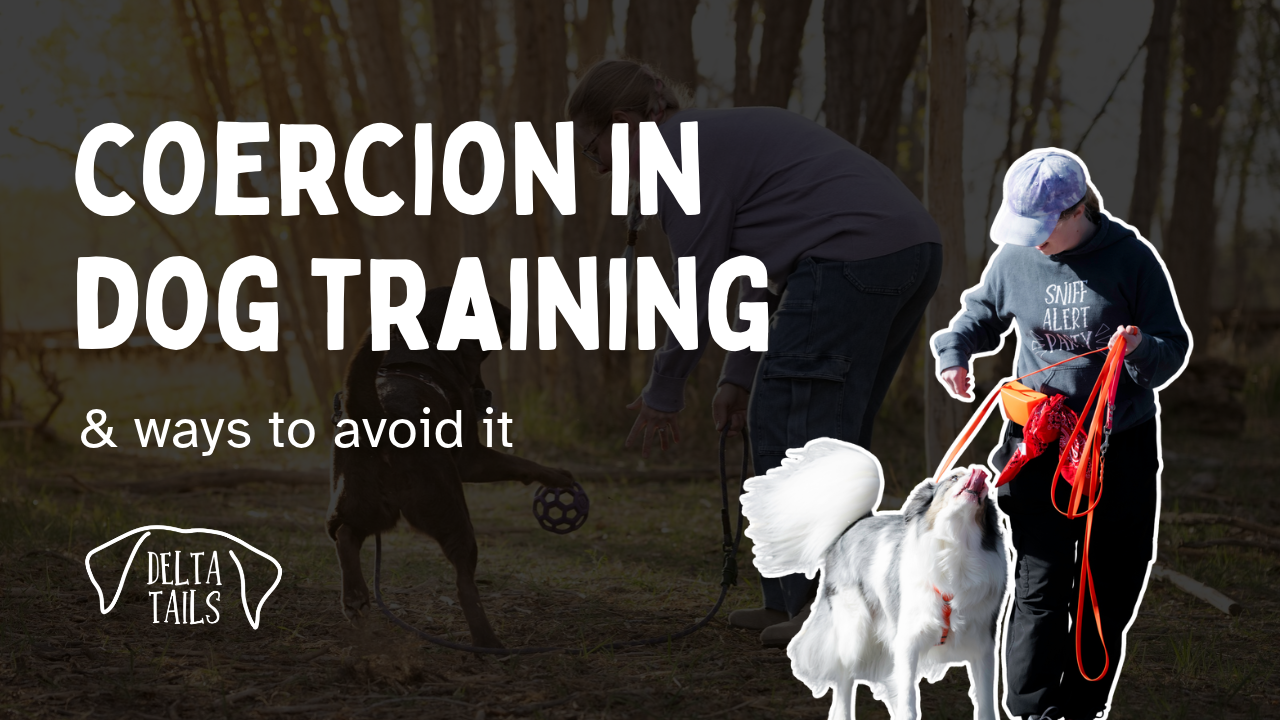
The definition of coercion: the act, process, or power of compelling someone to act against their free will through express or implied threats, intimidation, psychological pressure, or physical force.
With force free training methods, we intentionally avoid threats, intimidation, and physical force.
But psychological pressure can happen really, really easily while training, regardless of the methods you choose to use.
Hidden Ways Coercion Can Appear in Training:
- Deprivation of food or other basic needs
- Moving higher and higher up the reward value scale when your dog doesn't listen
- Tone of voice while cuing
- Persistence in cues or handling
- Handler's body language
Food/Basic Needs Deprivation
Food deprivation (or other basic needs) can become very pressuring and coercive. A couple examples are asking our dogs to always work for their meals, or asking them to perform something before they can go potty, have an enrichment toy, or eat their food.
Because of this, the dog learns that doing the thing that we ask them to do is the only way that their needs are going to be met, so they no longer really have a choice.
This is similar to the "nothing in life is free" mindset that used to be highly prevalent in dog training circles years ago. This has since been (mostly) replaced by the phrase "plenty in life is free," which was coined by Kathy Sdao in her book titled the same thing.
Higher Reward Values When No Response to Cue
This is when the handler or trainer continuously raises the reward value until the dog performs the cue, despite the dog's discomfort or signs of saying no.
I see this often in cooperative care situations, vet clinics/visits, and anytime I'm working with a dog who has some fear or anxiety. But this can also happen in service dog training. The dog is not responding to a cue likely because they're overwhelmed or stressed, and the person will just continually raise the treat value until the dog will do the behavior.
This seems harmless on the outside - we're just giving them better rewards!
But to the dog, this means that even though they have said no, the rewards will be used to make it more difficult for them to refuse, ignoring their signs of discomfort, stress, or overarousal.
Tone of Voice
Raising your voice consistently until your dog listens is a form of social pressure and can feel intimidating to the dog, especially if there is a history of not so enjoyable things happening after a louder voice.
The dog learns that if they don't respond to a cue, you will get increasingly more and more loud, which they don't enjoy.
Instead of saying no, it becomes easier for them to just do the thing to avoid the pressure and discomfort.
Persistence
Persistence goes hand in hand with the tone of voice. Repetitively cuing your dog over and over or handling them when they've repeatedly expressed discomfort teaches them that you won't allow a no.
Think about it as persuasion and wearing them down. The more that you ask, the more pressure builds and less they feel like they can say no.
Eventually, they give in to stop the pressure.
We want our dogs to be listening to cues because they're comfortable and they want to play the game with us, not because we've asked 5,000,000 times and they're tired.
Handler Body Language
This is very easy to accidentally do to our dogs, since we absolutely speak different languages!
Things like:
- Hovering over top of your dog
- Blocking your dog's movements
- Preventing access to a way that they could say no
- Walking straight at them directly with intensity
- Stomping your feet or clapping your hands
- Making eye contact
- Petting or handling them without indication of enjoyment
All of these things can feel intimidating to a dog, even if we as humans don't view it as such.
This is because we speak different languages with our bodies, and we need to learn how to move our bodies to help our dogs feel comfortable.
How to Avoid Coercion in Training
Above all, listen to your dog.
Let them say no with just their body language. They don't necessarily have to opt out or do a specific behavior. You should be watching their body language as well, and you should respect it when you see those signs.
When your dog is saying no to things that are absolutely needed, like trimming their nails, going to the vet, etc, then you should work hard to adjust those tasks to be less stressful for your dog.
That can be through pharmaceutical help to help lower their stress threshold or an alternate activity like a scratch board for nail trims for example.
Learn to read your dog's body language well. If they show signs of stress or discomfort, that means that they're saying no. Even if they are performing cues, eating food, doing the behaviors.
If you see stress signs, stop.
Don't push or prod your dog. If they're not listening, that's information for you, not a reason to continually ask them.
Always allow free access to all of their needs without stipulations. That means their food, their water, exercise enrichment, rest, safety, and security.
Coercion is a difficult topic because no one wants to act this way towards our dogs. But it can happen accidentally so very easily!
If this is one of the first times you're hearing about coercion and how it can appear, or maybe you've done some of these things in the past, that's okay.
We've all accidentally been coercive towards our dogs, even those of us who have known about it for quite some time. It can be sneaky!
Now that you know about it, just make a promise to your dog to always be watching out for coercion while training. And if you notice something going a little sideways, adjust!
Your dog will always be thankful for that. :)
Join the Pupdate!
Meet the Writer

Blythe Bouchard (Neer)
CDBC, CPCFT, CSAT, CCUI, CNWI, FFCT, Puppy Start Right Instructor, Dynamic Dog Practitioner
Hi! I'm Blythe. I've been training dogs professionally since 2019, and it is my life's passion. I love watching dogs and owners come to understand each other better and work together in harmony.
Recent Posts
Join the Pupdate for weekly tips, tricks, and motivation to train your dog at home.